Thursday, 1 October 2015

MAN'S BEST FRIEND

Of no particular breed, Indian dogs roam the streets of cities and towns throughout India.  Aggressively territorial they stake their claim to a street or area and become its guardians, fending off any perceived intruders, bearing their teeth, snarling and occasionally biting a passer-by.  They are of medium height and usually yellow or black.  Their scruffy, injured existence, finds them anywhere and everywhere, sometimes alone, sometimes in groups scavenging for food, unloved and scarred by battles with man and animal, alike.

The large yellow dog who roamed my street was different - he'd lost a leg and now ran on three, seemingly unimpaired by such an awful loss.  He had developed a barrel chest of muscle to make up for the missing front right appendage - he was a big dog and when I first made his acquaintance, I wasn't sure if he was dangerous - so I approached him cautiously and so we got to know each other.  Every day he would come for a greeting and I would pat his side.  This was our sole contact.

Returning to India after an absence of 2 years, I found the neighbourhood changed beyond recognition - multi story tower blocks had sprung up in a frenzy of building activity - my friend the dog - I called him 'Touser', for want of a better name or '3-legs', was nowhere to be seen.

I had been back a few months when one day I set off in the morning emerging from the driveway into the road - I hadn't walked many paces when I heard a far-off bark, a couple of streets away.  Instinctively I knew that it was directed at me.  I walked on looking up the road into the distance and saw a yellow shape tearing down the road ahead - as the dog got nearer I could see it was running on three legs.  With wagging tail and anxious look 'Touser' could barely contain his excitement !  I crossed the road and he rushed at me, sole front paw up on my chest, tail wagging, he licked my hand in welcome, got down and made a rush at me again.  His joy was palpable.  I marvelled at this little miracle - he'd recognised me from a distance after an absence of two years and not forgotten a friend !

Saturday, 12 September 2015

MULTI TASKING INDIAN STYLE

The Documentary Film Maker was to give a presentation of his work in retrospect.  He was 77 years old with an unlined face and dapper figure, without a centimetre of fat anywhere to be seen.  He had won numerous awards for his films, although some had been banned, as being too controversial.  A Documentary Film is essentially story telling, based on known facts - he explained that his motive in making films was to inform and communicate to as many people as possible.  He pointed out that film can reach a wider audience and has the power to move people to action, quite spontaneously.  Ideas came to him from everyday experiences.

Interestingly, this 77 year old film maker was also a Katak Dancer and at the end of his talk, the audience begged him for a demonstration.  Without being asked twice, he whipped off his socks and gave a demonstration of movement, balance and flexibility with a face radiant with energy.

Did the Katak dancing inform his Documentary Film Making or was it the other way round ?  But what is common to both, is the technique of story telling, whether it is through dance and mime or acting and dialogue !

Sunday, 9 August 2015

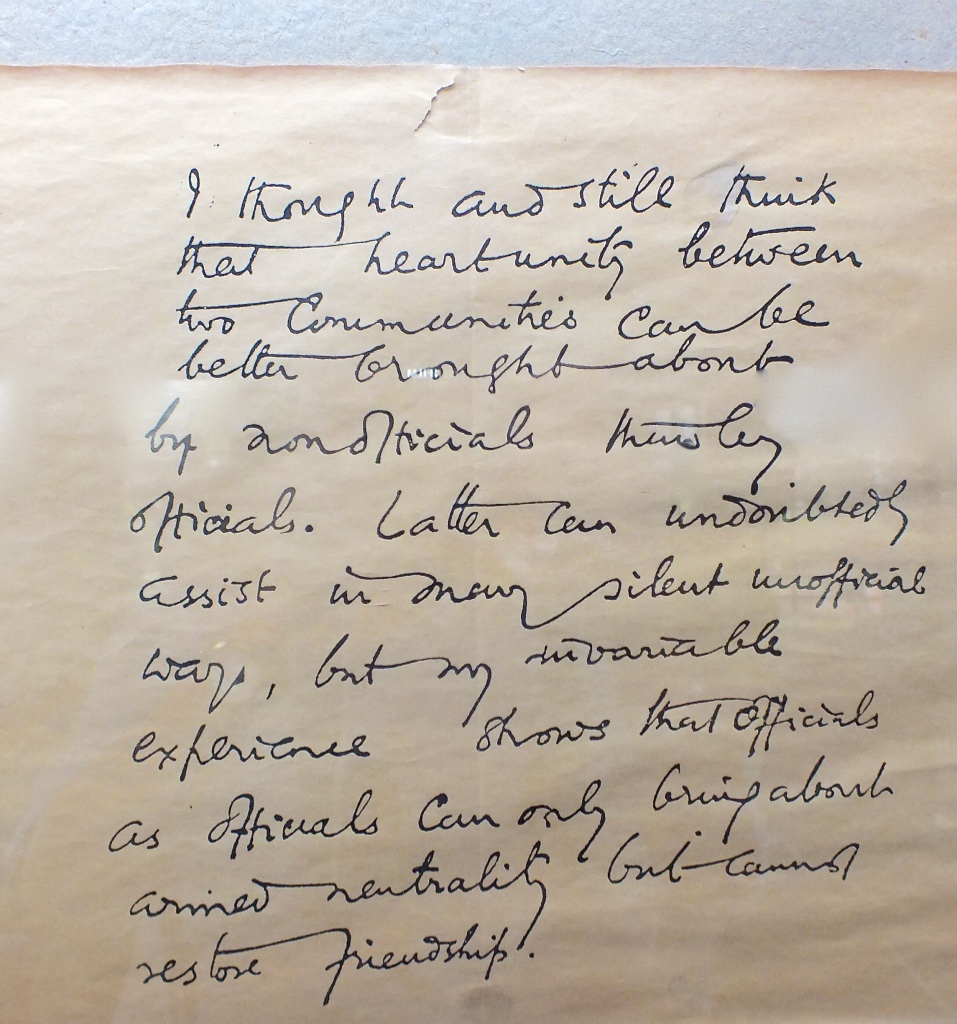
MAHATMA GANDHI AND GRAPHOLOGY


In France, graphology is a very important means of assessing the application of a future employee and determining his suitability for a job.   Standing in the quietness of the Gandhi Ashram in Ahmedabad, I studied this beautiful handwriting of Mahatma Gandhi (1869 - 1948)  and wondered what a Graphologist would make of it.  The calligraphy is flowing and confident - i's are dotted and then elegantly looped in attachment to the next word, the tails of y's are similarly looped up to the next word, as are the cross bars of the t's - the rhythm is a perfect balance between forward movement and a long pause. 

Gandhi was born in Gujarat and trained in Law at the Inner Temple in London.  After a stint in South Africa, where he formulated many of his ideas about Civil Rights and Freedom, he returned to India.  He lived at the Ashram in Ahmedabad on the Banks of the Sabarmati River for 12 years and set up a tertiary school for manual labour, agriculture and literacy.  And it was here that he embarked, with 78 companions, on the 241 mile Dandi Salt Protest March in 1930, to highlight the unfairness of the salt tax.

I wondered whether his thoughts would be any different, when applied to the toxic global community that we live in now....!

Monday, 3 August 2015

CHECKS AND STRIPES IN MALABAR


Surprisingly these beautiful colours are 100% organic dyes, the herbs sourced from the forests of the Western Ghats of India in the Northern most part of Kerala, an area known as Malabar.  This mountainous area running parallel to the West Coast of India is a UNESCO World Heritage Site, with a fascinating biological diversity and forms one of the 4 water sheds of India.

Weaving centres were set up in Cannanore, Calicut, Chombola and Tellicherry, under the patronage of the Basel Mission who were active in India from 1834.  Their objective was to pass on Christianity but the main focus of their work was to create employment opportunities for the people of the area.  So they taught printing, tile manufacture and weaving.

Traditionally the local villagers used small pit looms, weaving cotton fabric in their homes, but the Basel Mission, imported huge frame looms and the fly shuttle from Europe and for raw materials, they introduced scientific methods of cotton cultivation.  Women were employed as thread makers and spool winders, giving them economic independence.  Large sheds were erected to house the equipment and in this way they transformed what had been a small cottage industry into an economic enterprise.  By the early 20th c they were the largest industrial entrepreneur in Malabar.  Cotton fabric was exported all over the world, but particularly to Europe.  Kakki mill cloth for the armed forces was manufactured for the first time in India by the Basel Mission !

However, the World Wars saw their influence diminish and by the 1930s many of the Malabar
weaving centres had come under the jurisdiction of the State of Kerala, although small private concerns still exist.

The cotton fabrics in the picture above, are part of an exhibition being hosted by a private weaving centre in Gujarat.    

Thursday, 6 February 2014

A FAMILY MATTER

It was the Garba season and monsoon rains and continuing heat did nothing to diminish the general excitement as girls bought garba skirts in bright colours, embroidered with sequins and mirrors and skimpy tops to reveal an expanse of naked midriff.   Nine consecutive nights of dancing, in a swirl of pulsating rhythm and sweat - a test of endurance and stamina, in which everyone participated.

The girl from the slum hung out her spangled skirt to dry, the next festival would be Diwali, some weeks later.  She washed clothes for a living and I could hear her wooden paddle every morning, as she beat and scrubbed the garments in a monotonous and continuous rhythm.

But that night at about 10 p.m., everything changed.  She had met a boy - her father didn't approve.  A fight broke out, raised voices at first, but becoming louder and louder, as his fury increased - the family milled around - the sound of slaps, as blows rained down on the girl.  The situation grew more and more violent and her cries and protestations were of no use - the anger seemed to crescendo in intensity, like a tropical storm.  "Papa, papa",  she wept and cried out in broken, desperate, sobs.

The horrible sound of domestic violence and a terrible beating, continued into the night.  At 7 a.m. the next morning, broken, she whimpered in agony, as they tried to move her.  A few weak, groans and then she slipped away.  A man and woman ran from the dwelling, as if blown by a wind and the shock and finality of her death, was palpable.

A woman appeared wiping her eyes with the edge of her sari, as others used cell phones to spread the news.  Someone was summoned from the town and a group of women stood in a close circle, as they negotiated the cost of funeral arrangements and a stretcher to bear her body away.  As money was counted out from a large wad of notes, it reminded me of a painting or etching, by one of the Northern Renaissance artists, perhaps it was Durer, of the betrayal of Christ by Judas for 30 pieces of silver - the same furtiveness, as money changed hands, in exchange for a life.

By 11 a.m., a few more people had arrived - a gathering.  The girl's body was lifted onto the stretcher, covered in flowers and borne away.   There was a sense of catharsis, of spent anger, calm after the storm.

The next morning, women of the family, washed every piece of clothing, every sheet or mat - every vestige of the shocking night of violence.  And so they moved on with their lives.

"What happened?" I asked the watchman, some days later.  He looked at me quietly and said..."Madam, it was a family matter"........ and with that he turned away.

Tuesday, 28 January 2014

90' UP !

They didn't exactly shout 'timber', but whatever the local dialect was for 'mind your head, coconut on the way down' !  They were harvesting coconuts at Coconut Creek in Goa.  The South of India produces 90% of India's coconut production and it brings in a good income for the 'strapped for cash' Southern States.  Every part of the coconut is used, coir from the fibrous outer coat, the hard shell itself, produces charcoal, the water of the 'Jelly Coconut' is highly nutritious, containing proteins and antioxidants, then there is oil from the kernel and coconut milk and flesh,  are used in cooking. Even the palm fronds are used for making brooms, etc.

Coconut palms can grow up to 98', so no mean task for the contract workers to shin up the trunk, using footholds cut into the bark and a short rope round the trunk for leverage - they cut the heavy fruit with a panga and down it thuds, with a huge wallop, capable of killing or seriously injuring anyone underneath !

The palm tree, like no other, evokes an image of exotic tropical islands, fabulous holidays and happy sunshine.  But the palm frond is also a symbol for the Christian pilgrimage and the coconut itself, is used in all Hindu Religious Ceremonies, where it is offered to the God, as an important part of the ritual.  And if you want your prayer to be answered, after a visit to a temple, you smash a coconut with gusto and drink the contents !

Harvesting Coconuts


Monday, 27 January 2014

GOA, AGAIN

Landing on the lap of Goa, like a tired seagull, after the frenzy of India, the laid back serenity of this coastal state, always takes you by surprise.  The calm Arabian Sea, an endless blue horizon, palm trees and mood of 'doing nothing in particular',  offers a very different experience, to the rest of India.

After the sun goes down, the perimeter of the bay begins to light up, as careless twirls of neon lighting illuminate the decks of shabby shacks and visitors from Europe sip aperitifs, enjoying leisure and liberty to the background beat of '70s rock music.

Wednesday, 22 January 2014

A WEE DRAM OF WHISKY ?

Or perhaps the question should be:  "Would you like to share a tetra pak with me?" !  In the Liquor section of the supermarkets in Bangalore, Indian Whisky is sold in tetra paks, without the straw !  I'd never seen liquor sold this way before....  apart from cheap red and white wine in Italy.

Coming from the dry state of Gujarat, the accessibility of alcohol, is a novelty.  Cane sugar juice or fresh lime soda, are the usual drinks offered at functions, in lieu of anything stronger and one of life's little pleasures when traveling to another state, is being able to order a cold Kingfisher beer.  Foreigners working on contract in Gujarat, apply for a license to drink alcohol - they're allowed a limited number of units per week, all of which are recorded in a little 'pass book' and stamped by the small liquor store, tucked away in a side street.

Of course the illegality of alcohol doesn't prevent people from drinking and the newspapers often report the deaths of people who have drunk a homemade concoction from the Mahuda Tree, which has proved lethal.

Regular checks are made by police to prevent bootlegging and parties where alcohol is to be served, are clothed in secrecy - the venue for the event being sent out by sms to invitees at the last minute !   Imported wine is very expensive - a glass of ordinary Italian Red Wine can cost you around £12 a glass and champagne - £25 a glass... and Indian Wine is just as expensive,  which makes spirits a more obvious choice - 'Bombay Sapphire' definitely being one of the best gins on offer !

Whisky was introduced into India during the British Raj, early in the 19th century.  The original distillery, in the North of India, is still in operation producing a blend based on the fermentation of molasses, readily available from sugar cane.  But the whisky in the tetra pak, called "8 PM", is a new high quality, grain based whisky, which is more mellow than its molasses based equivalent and growing in popularity with the upwardly mobile !

Sunday, 19 January 2014

OUT OF CONTEXT

The exhibition of 17th century Flemish paintings at the CSMVS (Chhattrapati Shivaji Maharaj Vastu Sangrahalaya) in Mumbai was the first of its kind and a rare event, funded by the Port of Antwerp.  The rationale behind the idea was a collection of art offered from one harbour city to another, in recognition of the fact that port cities are doorways to other cultures.

The paintings were on loan from Antwerp's Royal Museum of Fine Art and the engravings from the Plantin-Moretus Museum.  It was strange to see Western Art in the context of India - candlelit interiors, fine brocades, still life, biblical and mythological subjects, lovingly depicted in all their infinite detail.  "The Massacre of the Innocents", "Samson and Delilah", portraits of wealthy patrons with elaborate lace cuffs and collars, emerging out of the Rembrandt-esque gloom of oil paint on canvas, perfectly lit with all the realism and skill of the artist.  But what of the relevance for another audience, unaware of the strategically placed symbols and double entendres ?

But interestingly, the exhibition was also about the rising middle class of the time in Europe - the new bourgeoisie, about foreign trade and invigorating economies, made possible through contact between countries and continents.  About reinforcing values and the structure of the family, emphasising the positive benefits of trade between nations.

Aside from this, seeing these art works, outside of the context of Europe, sharpened their narrative power and admiration for Flemish artists of the period.

SIZE ISN'T EVERYTHING

The ubiquitous banana, readily available as a staple fruit in every country, exists in many different varieties in India, from the usual shape and size, with which one is familiar, to very large thick skinned green bananas, called plantains, which turn black when ripe, with a creamy to slightly pink flesh.  Though found in the fruit section of a supermarket, they're cooked as a vegetable and are less sweet and more dense than a banana and more nutritious - they're also sliced into thin wafers and fried, to make a delicious dried snack, sprinkled with salt and pepper, like a potato crisp.

But it is the pygmy banana, grown in South India, which is prized above all for its flavour and firm texture.  These small bananas, readily available in the South, are sent by truck to other states and whenever a load would arrive in Gujarat, they were quickly bought off the truck, never seeing the inside of a supermarket !

Pygmy bananas - life size


Sunday, 5 January 2014

MORSING IN KUTCH, GUJARAT (JAW HARP)


The oldest instrument in the world, known by various names, but called 'Morsing', in Kutch.  The magical and characterful, Samadh, Headman of the Pathan Village, like a true host and showman, gave a demonstration of this amazing instrument.  He claimed to be the only person in the world who could sing and play at the same time !  Since it requires being played through clenched teeth, this is no mean achievement.  It wouldn't have been at all surprising to find that he owned a flying carpet as well !

Friday, 3 January 2014

PASSING THROUGH

Shady streets lined with gigantic, spreading, Rain Trees and neanderthal, Banyans, their canopies arching over everything below - their aerial roots trailing thick tendrils vertically down, bringing to mind exotic jungles, Rudyard Kipling and Mowgli - symbols of a bygone, 19th century age.  The Victorian and Art Deco buildings of Colaba, with their peeling paint and sagging balconies, add to the sense of time slipping by.  And yet this dilapidated splendour is what makes Mumbai the unique place that it is.

"I love Mumbai" said the taxi driver "I was born here and have always lived here....you can do anything you like and go anywhere you like - nobody asks questions - there's so much freedom and plenty of food to eat.  I have my mother, wife and two daughters with me and I'm putting both girls through college - I'm a happy man" !

Colaba, Mumbai


Tuesday, 31 December 2013

THE NEW YEAR

New Year in India depends on your region of origin and your religious beliefs - the Bengalis celebrate New Year in April, as do the Punjabis.  The Gujarati New Year is the day after Diwali in November, according to the Lunar Calendar.  For some, the date is linked to the winter solstice and the harvest festival, heralding a new financial year.  You become accustomed to wishing various Indian friends and associates, a 'Happy New Year', at the appropriate times, throughout the year.  So the Western, Christian, Gregorian solar Calendar year end,  in place for centuries in the West, is a fairly low key affair in India and is not greeted with the huge pyrotechnic displays of the West !   Though some of the big international hotels do make an effort, for the sake of their guests - like the ice sculpture of 2014 !

'2014' - ice sculpture


Saturday, 28 December 2013

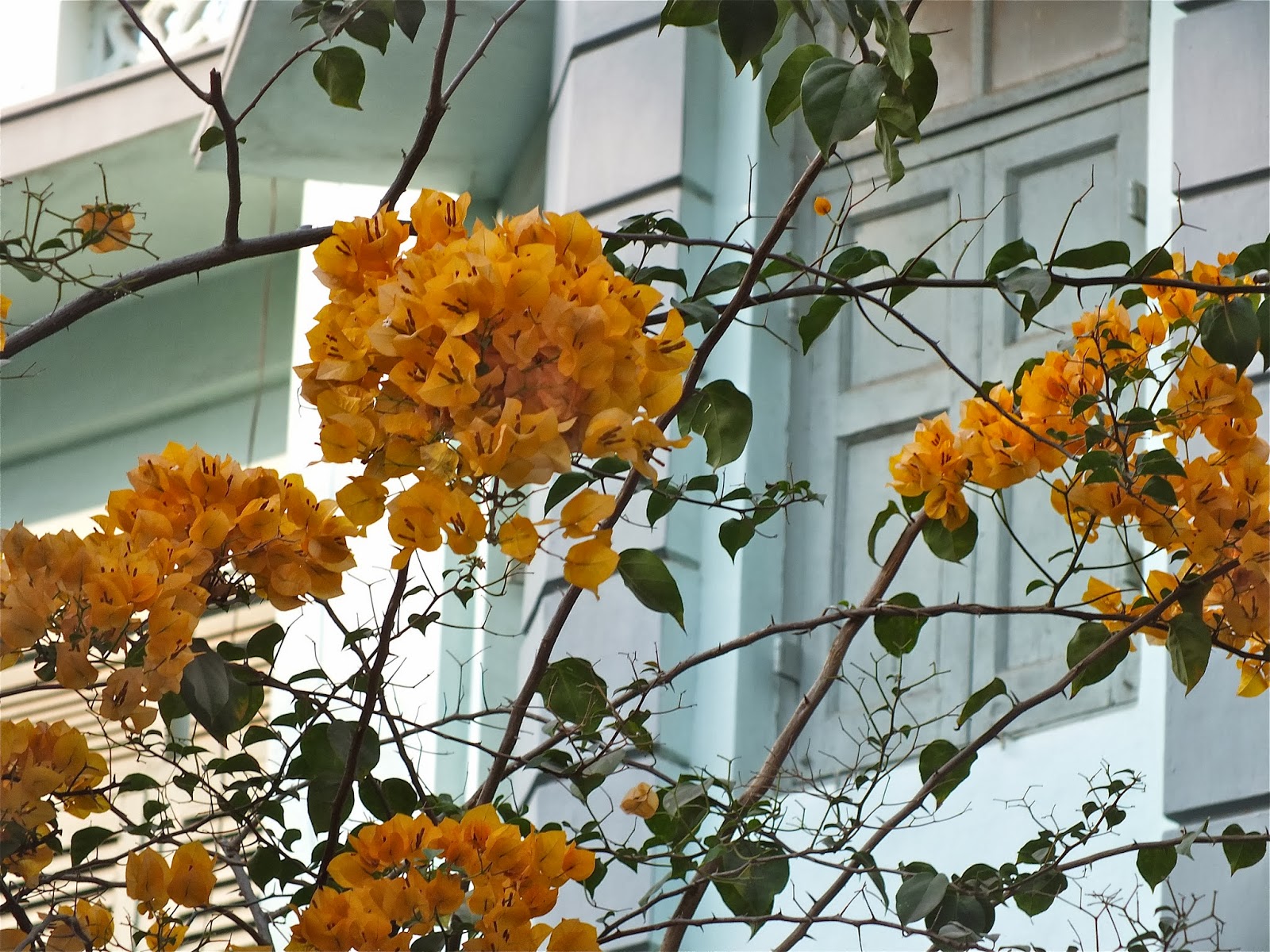
GOLDEN BOUGAINVILLEA & PALE GREEN ART DECO


BORDER CONTROL

I had always thought that only Italian women could get away with wearing sequins at midday in the supermarket !  But India changed that misconception - sequins are worn everyday by everyone, even in the hot, dusty streets, buying veggies off a barrow !

The most mundane fabrics can be transformed by bling, they even drape it over their vehicles to ward off the evil eye !  The cotton and clothing industry is big business and the warp and weft of it runs through society.  Sari shops are a dominant part of the urban landscape, tailors abound and colourful fabrics explode out of shop entrances.  And if you don't like the colour, you can have it dyed to suit your palette !

But the shops which offer the most possibility for transformation, are the Border Shops.  Row upon row of fabulous borders in all sizes, colours and designs are a visual delight.  Many of them are hand embroidered in lengths of 8 meters, to be sewn onto a sari, or narrower borders to sew onto a kurti or tunic. The proprietor of the shop usually has an expert eye for colour coordination and a good understanding of ratio and proportion, for this specialised art form.  The border, like a piece of applied art, can define and enhance the garment, raising it to another level - into something unforgettable   !


Sunday, 22 December 2013

AWAY IN A MANGER......

The Christmas Carol ran through my head.....but the cows of Gujarat have no manger apart from the city streets !  They are very docile creatures, with their large expressionless eyes, long drooping ears, huge curved shoulder hump, proud upright horns and slow unhurried gait, as they create their own traffic chaos, crossing roads wherever they see fit, or even lying in the middle of the road, traffic parting on either side, to make way for the obstruction !

In the Monsoon season, they head straight for the town, where they can find dry roads and buildings under which to shelter and in winter, they prefer the town environment because the streets are warm and they can be seen sitting in groups of 5 or 6 on the dusty roads, their eyes closed, soaking up the heat of the sun.

New calves are born in this winter season and they quickly learn how to get around the city streets, under the watchful and protective eye of the mother.  However, I'd never seen a calf riding on a scooter before - the farmer had the new born over his lap, presumably transporting it out of town, but what was remarkable was the docility of the small creature, who seemed to accept this as a perfectly pleasant way to travel - but the mother cow's reaction was quite different !  I hadn't realised how fast a cow could move until I witnessed this incident - she was in hot pursuit, at a canter, keeping up with the fast pace of the scooter, her heavy udder swinging, as her hooves clattered over the road, determined to keep her new born within sniffing distance !  Her anxiety and distress were palpable.  The unshakeable maternal bond which transcends all obstacles !